What actually ranks — watch time, sends, likes
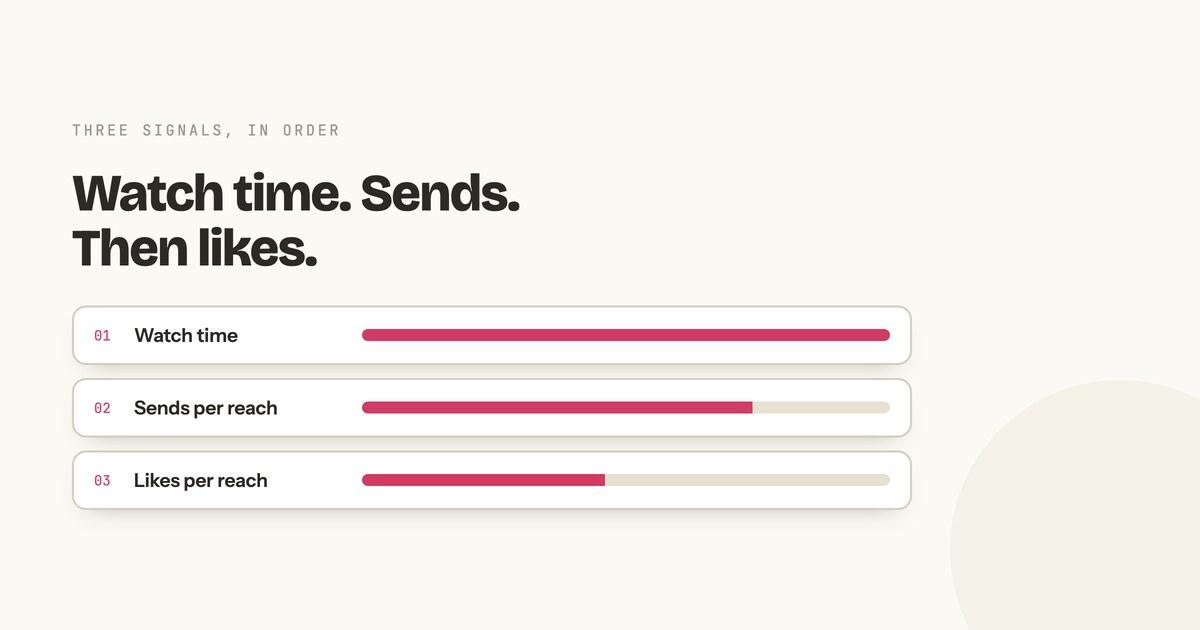
Instagram's own head named three signals. Follower count and posting streaks are not among them.

There is no single Instagram algorithm any more. Feed, Stories, Reels and Explore each run their own ranking system, and they weigh things differently. That is why advice that worked for someone else's account often does nothing for yours — they were optimising a different surface.
But Adam Mosseri, who runs Instagram, has named the three signals that matter most. They are worth knowing precisely, because two of them are not what people optimise for.
1. Watch time
Not views. Not the play count. How long people actually stay.
This is why a shorter video often beats a longer one: completion is easier to earn at 20 seconds than at 90. Completion rates differ sharply by platform — around 72% on TikTok for sub-30-second clips, 61% on Reels, 54% on YouTube Shorts. The same file does not perform identically in three places, and it is not supposed to.
The practical consequence: cut the first two seconds. Almost every video has a run-up that costs more in drop-off than it adds in context.
2. Sends per reach
How often people share it in a DM, relative to how many saw it.
This is the signal most people never think about, and it is the one that behaves most like a recommendation. A like costs nothing. Sending something to a specific person costs a small amount of social capital, so it is a much stronger vote.
You can design for it. Content someone would forward to one particular friend — a joke that lands for a specific group, a genuinely useful tip, something recognisable — earns sends. Content that is broadly agreeable earns likes and nothing else.
3. Likes per reach
Still counted, still last of the three, and importantly a ratio. Ten thousand likes on a post that reached a million is a weaker signal than four hundred on a post that reached a thousand.
What is not on the list
Follower count. Posting streaks. Hashtag volume. Publishing at some magic hour.
That last one deserves a note, because it is the most repeated piece of advice in this field. Your posting time matters mainly in that it should be a time your existing audience is awake. Beyond that, the ranking systems distribute over hours and days, not minutes — which is exactly why scheduling a post for 18:30 rather than publishing it by hand at 18:30 costs you nothing.
How this fits with cadence
Frequency is a floor, not a lever. Enough posts to stay in circulation, then everything else is decided by whether people watch, share and react. Posting twice as often will not rescue content nobody finishes.
Which is the useful reframe: consistency buys you attempts. The three signals decide what each attempt is worth.
Sources: Buffer, Hootsuite, DigitalApplied — how algorithms work.
More Articles
Consistency beats volume, and the numbers are not close
Posting more is not the lever most people think it is. Posting without gaps is.
August 30, 2026
One file, every platform — the 2026 spec sheet
Shoot 9:16 at 1080×1920, keep what matters in the middle, and stop exporting four versions.
August 28, 2026